Showing posts with label watching. Show all posts

Sunday, 30 May 2010

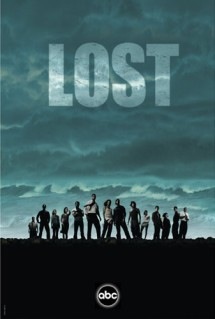
What I've Been Watching: Lost - Final Thoughts

88063A59-6A1A-43E7-99DC-A6A9C96BB8F7.jpg"The longest single story ever told on television" Whatever else Lost was, it was surely that. Perhaps only Battlestar Galactica has come close to telling such a long, extraordinary tale. Unlike most television, which tells a new story each episode (CSI, House, etc.) or each season (The Wire, Buffy, and so on...), Lost's story lasted six seasons, with a clear beginning, middle and end.

As such, it frustrated and engaged fans in equal measure; as they debated the meaning of numbers, four-toed statues, smoke monsters and polar bears. Of course, the reality is most of these questions were answered in the final season. And even the most hardcore of fan cannot have expected every single thread to be tied up in its final episode.

However, this was the show that took its fans and its mythology incredibly seriously. The final season showed just how much the writers had invested in the show. Time and again we saw things that had happened 5+ years ago being referenced, and it's a testament to the show's ability to create memorable moments and mysteries that we were able to remember precisely what it is they were referring to.


Season 6 Review
(SPOILERS FOR THE FINAL SEASON AHEAD)

The final season was based around Jacob and NotLocke: the two brothers who had been bringing and testing people on the island for at least 150 years. After Jacob's death at the end of season 5, the island needed a new protector, and so 'the candidates' emerged.

The battle between the brothers provided the backdrop to the season, as we saw how they're differing opinions on humanity influenced their relationships with those who were washed ashore.

Jacob's final revelation that the reason for them being there was because their lives needed direction made surprisingly perfect sense of the events of the last six seasons. This was underlined by the reunions of all the characters in the FlashSideways (or perhaps more accurately, FlashUpwards) which were by far the highlight of the finale. More than once I had tears in my eyes as Charlie and Claire, Sawyer and Juliette, and so on were reunited. Hurley's understated remark to Ben that 'he was a good number two' likewise provided a surprisingly poignant moment.

If Lost's finale said anything, it was that the show was not primarily about the island and its mythology but rather the relationships the Losties made there. Relationships that allowed each individual to put all their worries and concerns to one side in the alternate reality and enjoy life again.

My only 'theory' about the ending is that when each Lostie died, instead of being reborn again, they went straight to boarding Oceanic Flight 815 - any memories they had being false ones based on memories of their real lives.

The reason I think this, is because it is clear the flight was supposed to be the most significant event in their lives, and it makes perfect sense their brain would go straight there to relive it. So as soon as they die, they go straight onto the flight in order to reach their final destination with the people who were most important to them.

CAC4E4A4-0F21-48EF-8070-B8AC9289359E.jpgAlthough Christian Shepherd's revelation in the final fifteen minutes kind of came of the blue, upon reflection I think it makes perfect sense. At my most cynical I could say limbo was just an excuse to bring all the old cast members back, and their reasoning behind not having Shannon on the plane makes zero sense.

However, the season certainly set-up these religious themes: the epic battle between good and evil; finding one's destiny; and earning one's redemption. In the context of these themes, introducing limbo or heaven into the equation I have no real problem with.

Fan Reaction

Finally, it's interesting to consider fans reaction to the finale. A reaction which it seems has been somewhat mixed. Perhaps the weakness of doing one story over six seasons is that fans have so much invested in the show, and have come up with so many theories about the island and the overall story the show is trying to tell, that they'll inevitably be disappointed when the show diverges from their own interpretation.

However, as I mentioned in my television review of the decade, the appeal of Lost to me has always be always been it's ability to surprise, and as such I should give the show credit for continuing to bring me with it for six years without ever really feeling cheated when new concepts like buttons, time travel, or alternate realities were introduced. Normally, shows would only introduce these type of things for one episode, with any plot holes, being easily ignored for the sake of that week's story. Lost meticulously established such grand concepts into the show's mythology, and for this it should be given a lot of credit.

I think when fans reflect back over the six seasons, they'll see a truly unique story that was unprecedented in its scope and ambition. Unlike Battlestar Galactica which 'Jumped The Starbuck', I don't think Lost has such a singular moment where fans gave up on the show. As such I think those disappointed by the finale will soon forgive the show as they reflect and re-watch the story in its entirety in years to come.

Monday, 24 May 2010

What I've Been Watching: Robin Hood & Hot Tub Time Machine

B6116532-8C24-4DDC-B4FC-FB1B3EBBD37F.jpgRobin Hood

From the team that brought you Gladiator, comes Robin Hood, Ridley Scott and Russell Crowe's attempt to do for The Prince of Thieves what Batman Begins did for The Dark Knight.

The film has been marketed as 'The untold story of the man behind the legend'. The premise is that Robin has returned from the crusades to find King John on the throne, who's country is bankrupt after an ill-conceived campaign in the Middle East (As as side note, aren't you glad to see things have changed a lot in Britain since the 13th Century...?)

There's also a bit about Robin Hood impersonating one of the king's knights. However, the only purpose it seems to serve is that said knight was married to Maid Marion: cue lots of awkward exchanges as they have to pretend to like each other to everyone else, while trying to hide their true feelings from each other. Apparently Ridley Scott thought this twist on the Robin Hood tale made the whole thing worth watching. It doesn't.

It's dull. Really dull. And it has no reason to be. Everything about this movie is brilliantly executed. The actors are well chosen, it's funny when it needs to be, the attention to detail in the world is spot on. What they forget to do was actually make Robin Hood an interesting character.

Perhaps it's worth considering at this point what makes a good origin story. If we think about Batman Begins, Casino Royale or even Spiderman, a big part of what makes them interesting is seeing them grow and develop into the legends we know they'll become.

So it's fairly common in these types of stories to see them say and do things we would never expect Batman/James Bond/Spiderman to do later on in their lives. For example, letting a robber get away with stolen money in Spiderman or giving up the secret service for a woman in Casino Royale

In Robin Hood, when we meet the title character, it may as well be at anytime in his story. He stands up for what's right, speaks his mind and has no problem with questioning authority. He makes no mistakes in the entire movie, and not once does he make a decision we would ever think to question. It's all very noble. And very boring.

I came out of the movie very disappointed since I really wanted to like it. It's not that any of parts are shoddy in any way, it's just that when you arrange it all together it's just a Volkswagen - it should have been a Porsche.

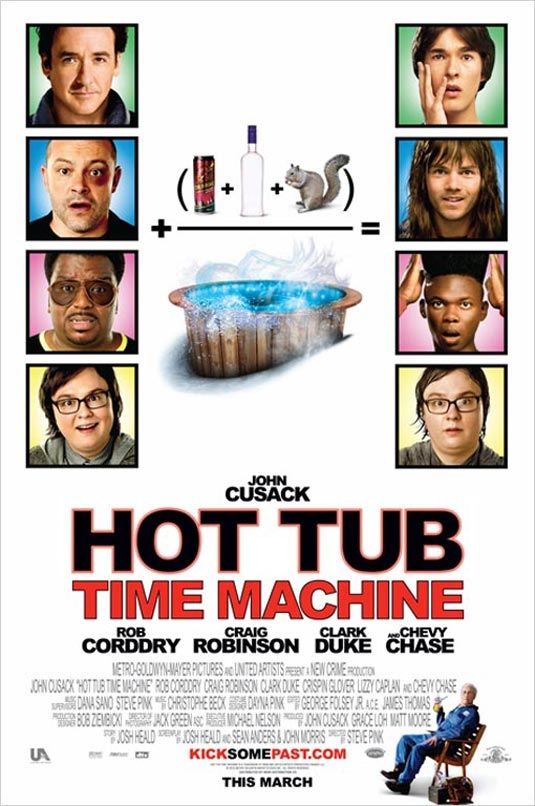
63BF0FA7-717A-433F-B58B-04A2D3C7C072.jpgHot Tub Time Machine

It's rare that a movie can so aptly describe/sell itself with just its title. Taking a leaf out of Snakes on a Plane, Hot Tub Time Machine feels like a movie where someone came up with a title and then started putting all the pieces together. They must have spelt out '1980'.

There's a great sense that the creative forces behind the movie love the 80s without feeling the need to apologise for it. "The 80s was a sucky decade, but it was our sucky decade" to misquote one of the movie's lines.

Unfortunately the film is quite a mess. At one point, as the characters partake in some male bonding, Lou declares Haven't you even seen Wild Hogs? This is a film that is doing its utmost not to go down the sappy, we all learn a lesson story of Travolta and co's movie. Yet it seems to be inexplicably drawn to it at the same time.

Characters do learn lessons: about taking risks, about standing up for themselves, and about taking responsibility for their lives. And in between we get jokes about sex, drugs and the 80s. None of which are that funny or that memorable.

The plot also makes no sense. At the beginning of the movie, it's well established that all their lives suck. And they get away for the weekend together to try and forget that fact. They get to the past, and spend most of the movie making sure they change nothing so it can all be the same. Why?

Most of this movie is frustrating, because at its best it knows exactly how ridiculous the premise is, and pokes fun at it at various points. Snake on a Plane had a concept, knew it was crazy, but stuck with it. Hot Tub Time Machine had a concept, but then couldn't decide if it wanted to be a Judd Apatow movie or Wild Hogs. As it is, it was neither. A rude, crude movie with a pointlessly tacked on message where people solve all their problems by changing one thing about themselves. All in all it ends up feeling just like the 80s: best left forgotten.

Monday, 17 May 2010

What I've Been Watching: DVD - Awaydays & American History X

2205C33C-574B-4F20-B972-B5322A331AB4.jpgAwaydays

Football Hooligan movies fill with me with a certain amount of dread. As a teacher I know the impact such films can have on young impressionable teens. Regardless of their attempts to show the consequences of such violence, there is still a level of style given to the riots between rival football fans that I feel filmmakers should take more responsibility for.

Awaydays does nothing to alleviate such fears. It features skinny teenagers taking on gangs of much older men and coming out with barely a scratch.

Despite this, it may not be the type of movie that would appeal to boys of that certain age. The story centres on the relationship between the main character, Catry, and Elvis. The latter appearing to have feelings that go beyond friendship towards the former.

The problem with the movie is not just that the characters are not particularly likeable, it's that they're also pretty difficult to sympathise with. Whether it's one trying to get the adrenaline rush of being in a brawl, another looking for the satisfaction of love that can never happen, or another trying to hold onto his youth by commanding a company of teens, I care little about their plight.

It's not that the film lacks ambition or has nothing to say. It's just that theyway the story is presented gives us little reason to care. Is this a story about the appeal and dangers of hooliganism? Is it about finding your place in the world? Is it about allowing other people to see the person you really are?

The problem then is not its stylishly shot scenes of hooliganism, neither its unsympathetic characters, but that Awayday's story lacks anything to hang onto - instead, it's as random and pointless as the violence it so readily depicts.


A9BC164B-E305-4F67-8C10-8CE2E2C02C0B.jpgAmerican History X

Another movie which readily depicts violence is American History X, a movie about the relationship between two brothers, the older of whom ends up in jail after a racially motivated attack.

Unlike Awaydays, however, this movie has no problems telling its story, even though it does so in a much more complicated, and hence interesting, manner.

Split between flashbacks in black and white, and the colourful world of the present day, both brothers are forced to face up to the actions that have got them to the place they are at now. The plot being propelled by the younger's assignment to write a paper about how the older one ended up doing time.

Where it excels in my opinion, is in its depiction of family. A family which, although dysfunctional, has little in common with The Tenenbaums nor The Simpsons.Instead they're a family broken apart by grief and resentment for an incident in their past.

Few movies manage to capture so well the many facets that make us who we are as a result of our upbringing and parental environment.

308D6EFE-89B9-41F8-8104-514EB88F7232.jpgYet as we dig deeper into what made Edward Norton's character become leader of a white supremacist group, we understand how such an intelligent youth could get it so badly wrong.

We also see how he becomes a father figure to his younger brother, and that Danny's need to follow in his footsteps can only have dire consequences for everyone involved.

Unlike in the world of procedurals like CSI and Without a Trace, the solving of a murder does little to bring closure to such a life-defining event and the consequences of seeing a loved one be killed will live with those closest to them forever.

There are many other aspects to American History X. However, upon first viewing this is the one that stuck out most. It could also be praised for its depiction of race relations, which felt incredibly refreshing - presenting few easy solutions to such a long-standing problem. Never mind Norton's outstanding performance, the narrative structure, the writing or the cinematography. Perhaps it's just best you see it for yourself...


Saturday, 8 May 2010

What I've Been Watching: Date Night & The Disappearance of Alice Creed

6DABEDA9-FB32-46F5-AC43-8A4EE6B87755.jpgDate Night
I've got a feeling...

30 Rock and The American Office have been two of the most successful, creative US comedies of recent years. They've deservedly made household names of their two stars: Steve Carrell and Tina Fey. So when I saw them on the poster for Date Night, my immediate reaction was: why hasn't anyone thought of this before?

This 'natural pairing' translates very well onto the screen as Fey and Carrell are asked to portray The Fosters, a married couple whose busy working/family lives mean they no longer have the energy to put effort into their relationship

The opening scenes to the movie almost come from another film, as the Fosters find out two of their best friends are getting divorced. Why? "They're just roommates. Really good roommates".

In an effort to spice things up a little, the Fosters decide to go to Manhattan for a night out. What follows is a case of mistaken identity which results in 'wacky shenanigans' for the next hour or so.

6828A81A-EAD0-4978-8D93-95088F9615E2.jpgThe film's strengths lie in the central relationship between Fey's and Carrell's respective characters. It shines when they're not figuring out where it is they need to be next, and instead just talking... (Yes talking, because if Annie Hall has taught us anything it's that a movie with people just... you know... talking can actually be entertaining). This 'talking' really felt like the kind of unique, smart comedy the two stars are known for.

To put it another way, I guess it's kind of like going to see a stand-up and instead of doing comedy, they decide to spend the hour juggling. It's not that their juggling is bad... I mean they had knives and flames and stuff... it's just that they're comedians... I wanted some funny.

So it is with Fey and Carrell, they're smart comedians, where's the smart comedy? Instead we got car chases, Tina Fey bumping into things, and pole dancing...

Despite all these set-backs, I was still entertained. It's easy to be won over by these two stars and the excellent supporting cast. I just wish the journey could have been as interesting as the company...

78FD469D-587D-4E68-B2C4-C48264A90CE2.jpgThe Disappearance of Alice Creed
Alice, Alice, Where the *bleep* is Alice?

There aren't many films that can sustain an interesting story with just three characters. Rear Window comes to mind as the type of movie that used just a few speaking characters to create over two hours of almost faultless suspense.

The first fifteen minutes of The Disappearance of Alice Creed would have you believing this movie is more of the torture-porn genre (e.g. Saw, Hostel) than the suspenseful thriller it later becomes.

In it, we see the two kidnappers, one in his forties, the other in their twenties meticulously set-up the flat they wish to keep Alice locked in. They sound-proof the walls, build the bed, and get all the supplies they'll need to carry out the crime. All without speaking. We then get a fairly disturbing piece of cinema, as Alice is captured, tied to the bed, stripped naked and photographed.

18330768-71D2-486E-9571-1645CF67DF87.jpgWhat follows, without giving anything away about the actual plot, is entirely different in tone. The movie chooses to concentrate on the characters, and the relationships that develop between the three of them. As a result it is much more like the tense and suspenseful Rear Window than the gory and disturbing Saw.

For a movie to work with just three characters, you need an excellent script and excellent actors. The movie has both. And although not perfect (perhaps the last act could have given us a little more), it's a very rewarding and exciting film to watch. It has a purity and innocence to its story that is very refreshing.

Unlike Date Night, which clearly had three or four creative forces all wanting different things, Alice Creed feels like one man's creative vision perfectly realised on the screen. Thoroughly recommended.

Monday, 3 May 2010

What I've Been Watching: Cemetery Junction & Iron Man 2

E4E92DB8-3F77-440D-8292-D1D838045F58.jpgCemetery Junction
A.K.A. Dead End

Mark Kermode, on his blog, posted a piece about whether a comedy needed to be funny to be described as such. He argued that despite Cemetery Junction's lack of laughs, it was still a good comedy because it was a good film. I would disagree with this argument. Cemetery Junction is simply not a comedy.

Given the involvement of Gervais and Merchant (The Office, Extras, The Invention of Lying) I can understand some critics' need to classify it as such. However, trying to cram it into that genre by redefining what a comedy is, seems to be completely missing the point.

Anyone who's seen the final episodes of The Office or Extras will know that these two writers know, not only how bring comedy out of the most excruciating of circumstances, but also how to build to great character moments. For example, when Dawn finds Tim's picture on her way to the airport in The Office or in Extras, when Andy launches a tirade on reality TV, while at the same time making a heartfelt apology to Maggie live from the Big Brother house.

15C763EE-68CE-4E74-BB63-9D5D78BA2874.jpgCemetery Junction essentially turns the comedy vs drama tables on us: being primarily concerned with these the latter, and only giving us little nuggets of funny in between. This was always going to be a risky move for these two writers, however, I think it's paid off pretty well.

Instead of the story moving in a direction that creates the most awkward, cringeworthy moments possible, we instead get a very tight, well-constructed plot about four people in the twenties trying to make something of their lives.

The characters, whether major or minor, are all incredibly well written and cast, with nearly all of them having moments that make you believe in their real, three-dimensional personas.

One other thing to look at is the significance of gifts in the movie, in particular, the manner in which they are given and received. Nearly all the important moments in the movie are when one character gives another things like a cup of tea, a beer, or a crystal bowl. Perhaps this best sums up the style of writing in the movie, where big things are said through little gestures.

Cemetery Junction then succeeds as a coming-of-age drama with a great heart and well developed character arts. If, however, you're expecting something with the comedic tone of Gervais' earlier works, I'd recommend re-watching your Office/Extras boxsets.

08572EC8-4D8F-43E3-B4F9-F7D5A074300F.jpgIron Man 2
He Came. He Saw. He Ironed.

When Iron Man was released in 2008 it was almost greeted as the second coming by some movie geeks. Its combination of snappy dialogue, a well constructed world, and a perfectly cast Robert Downey Jr leading some to question whether The Dark Knight, released a few months later, could surpass it for entertainment value. Needless to say, Nolan's Batman movie, is now considered the pinnacle of the genre. However, perhaps it's a little unfair to put the original on that high a pedestal.

You see, Iron Man is a film much like its main character: loud, brash, and cocky while at the same time wanting to do something worthwhile.

At the end of the first movie, it was incredibly refreshing to see a superhero finally 'come out' and admit to his secret identity. This dynamic is nicely used through out the sequel, as people are forced to believe in the man Tony Stark, as oppose to his alter-ego Iron Man.

Compare this to every other superhero movie, where the main character must decide what it is they stand for when they're dressed in their capes and cowls, and the impact this has on the normal people around them.

At the end of the first act of the movie Ivan Vanko (Mickey Rourke) targets Stark, and declares he has won because he made him bleed, he made him fallible. Arguably this resulting conversation is the high point of the movie. With the nature of Stark's new role in "privatising world peace" rightly questioned by this new enemy.

5A311444-B0D9-444F-BB33-DDC3E5113167.jpgUnfortunately, like the first it quickly descends into action movie territory in the final third, with all the interesting stuff put to one side in favour of more robots hitting each other. And we all know Transformers has cornered the market on that.

My only other complaint is the inclusion of The Avengers which will only really make sense to fans of Marvel comics. It still hasn't been clearly established why Nick Fury's S.H.I.E.L.D. organisation is so important, or what the threat it is they're dealing with. As such, the inclusion of these scenes in the middle of the movie made little sense in terms of the story of Iron Man 2. As well as causing it to suffer from Spiderman 3 syndrome as we were introduced to yet more characters.

Don't get me wrong I'm as excited as anyone at seeing Thor, Iron Man, Hulk, et al on the screen together in one movie, but I feel like more justification needs to be given to seeing Samuel L. Jackson pop up in the middle of each of Marvel's flagship titles.

Iron Man 2 is a movie that brought me with it for the first third, but seemed to run out of things to say by about half way. I never felt any real threat towards the characters, what it was Tony Stark was really fighting for, or what his dilemma in the movie was. As such, while entertaining, I don't think it holds up well when compared to the emotional heart of similar sequels like Spiderman 2, X-Men 2 or indeed The Dark Knight.


Reviews of Date Night and The Disappearance of Alice Creed will be published later this week.

Friday, 23 April 2010

What I've Been Watching: Television

A8C0C7D7-2C8C-4572-99DF-7DC5FFAAF7CE.jpgSarah Connor Chronicles: Season 2
The Mother of All Destiny

The Terminator franchise has had a somewhat turmultious history. Terminator and Terminator 2 are considered to be among the best sci-fi movies of all time, containing the performances Arnold Schwarzenegger will be remembered for. Terminator 3 was considered to be a fairly insignificant sequel, just about staying on the right side of average. Finally, Terminator: Salvation was generally considered the biggest disappointment of last year's blockbusters. Having few new ideas or stories to convince us the story Post-Judgment Day is worth telling.

Sarah Connor Chronicles sees the title character's battle to bring up and protect her teenage son, John. He has the unenviable task of leading the humans rebellion against their machine overlords in the future. They have the help of Cameron, a machine FutureJohn has reprogrammed to protect TeenageJohn. Confused? Try not to think about it too much...

Where as season one saw our happy family try to hide and destroy anything that could bring about the rise of the machines, season two sees them more accepting of humanity's fate.

The season is patchy in parts. At its worst, episodes are remakes of the original movies: with our heroes trying to escape a robot sent from the future. Also references to religion were completely misjudged and patronising. With one character being chosen to teach a machine morals purely because of his faith. The subsequent 'theological' conversations failing miserably to hit the depth I feel the writers should have been going for. Evidently, they hadn't seen The Two Cathedrals.

At its best, it compared the struggle to that of seasoned war veterans, who find it difficult to keep going with all the pain and suffering they've endured. Sarah's ongoing struggle to both protect her son, but allow him to become the man he needs to be providing an excellent undercurrent to all the series' events. The two extra protagonists they added, Riley and Jesse, proved to have the most interesting this season. Perhaps the reason they worked so well is that unlike the other characters, they don't have the baggage of the film's canon looming over them.

So a fairly uneven season, that did have some interesting things to say, although I feel the franchise it was based on actually proved to be a hindrance as oppose to a help. Sometimes I wasn't sure the type of show it wanted to be, and too often it would default back to slow motion shots of Terminators unceremoniously taking out an innocent bystander. This lack of forward momentum meant I found it difficult to engage with the storylines at points, and meant I wasn't as engrossed as I could have been.


Sarah Connor Chronicles: Seasons 1 & 2 are both available on DVD right now.

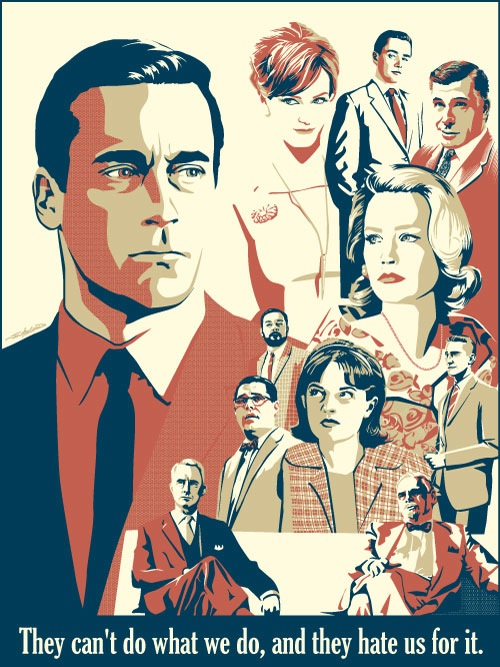
967896E7-F3B4-4899-A86B-7DE7951F5113.jpgMad Men: Season 3
Selling Your Soul

Mad Men has just finished its run on BBC4 and remains just as strong as ever. Set in the sixties it tells the story of an advertising agency in Manhattan.

In a story-telling form similar to The Wire, events take a while to get going, with little appearing to happen from episode to episode. However, since the show is based around on its characterisation, small events or comments can have huge significance later on.

Where the show succeeded most this season was in its amalgamation of its characters and real events from the sixties. In particular the way it handles (SPOILER for real life coming up) the assassination of JFK was a complete triumph. Masterfully combining both a realistic portrayal of how the news came out with possibly the most engaging character moments of the season.

In common with shows like Friday Night Lights and The West Wing (At least Seasons 1 to 4) it's difficult to separate this season's events from previous seasons. This isn't a show you can just pick up at some random point, but rather have to watch from the beginning. It has the philosophy that stories shouldn't explain everything to their audience, but should instead force them to lean in and engage beyond what is merely happening from scene to scene. As such fans of The Wire can rejoice, here's a show that at least comes close to matching its quality, patience and vision.

Mad Men Season 3 is released on DVD this Monday, 26th April in the UK/Ireland

6B7463B7-9BF2-43D5-A441-E033E1E6718E.jpgBeing Human: Season 2
Wanna Watch The Real Hustle?

Being Human has solidified its place among Great British Sci-Fi with its second season. Taking a leaf out of Buffy's book, it does a great job of allowing characters to grow and develop in response to the evil they're fighting.

Having survived a first season, it felt as though the writers had a very clear idea of where they wanted the characters to go this time around.

In particular, the way each episode opened with a flashblack to a character's past really did a great job of extending the world and mythology of the show beyond that of present day Bristol.

The villains for this season were religious fundamentalists. Being Human has dealt with religious themes before. In particular a quote from 1 Corinithians helping convince George to make a significant decision at the end of season one. However, despite some efforts to give a fair representation of religion, they failed: in the world of Being Human, religion is merely used to brainwash characters into unquestionably doing things they wouldn't do otherwise. Instead the villains of the piece were used to support a clear theme of Being Human: that the people we associate ourselves will end up defining us.

There was a great irony to this season, as the more our heroes were told they were less than human, the more they were pushed and attacked, the more monstrous they became. Violence and hatred breeding nothing but the same in return.

This led to a sense of brokenness and despair at the end of the season that had a uniquely British feel to it. Like Torchwood, the world created by the writers is one in which saving the day often comes at a price beyond that which the characters were willing to pay. I'll certainly be watching when the third season returns next year, this time with our characters relocated to Cardiff. Torchwood/Being Human crossover anyone?

Being Human seasons 1 and 2 are both available on DVD right now. (Region 2 only)

Wednesday, 14 April 2010

What I've Been Watching: DVD

D1F21E11-1A54-4F7D-AE90-CD7FCEC1D44F.jpgVera Drake
Anyone fancy a cup of tea?

Probably the most well known of Mike Leigh's films, Vera Drake is about a woman who carries out back street abortions without the knowledge of her family. Set in the 1950s, it explores attitudes to sex, families and gender roles/identities.

As I mentioned when I reviewed another of his films, Meantime, Mike Leigh has a very individual way of writing and directing his movies. He starts out with character descriptions which he gives to each character, and dialogue is improvised based on how conversations proceed.

Vera Drake however, is probably the most clearly constructed of his films. There are the same dramatic rise and falls we associate with most mainstream films, as well as character arcs with clear beginnings and endings. The dialogue, however, remains just as realistic and insightful as one has come to expect from Leigh. With short sentences, and characters revealing so much with so little. For example, Vera Drake, speaking of her secret life tells another character:

"I help out young girls"

A4E2DB31-F85A-44D6-9D38-59D336D84044.jpgFrom this we see both Vera's attitude and motivation for what she does. As well as the fact she is unwilling to explicitly spell out she is terminating an embryo, whether for fear of judgement, or because she is unwilling to confront it herself.

Lines like this are littered through out Vera Drake, as characters attempt to say things without upsetting social norms, to give an appearance contrary to the reality of the situation.

The issue of abortion itself is handled in an interesting way. The women Vera meets have both understandable and more selfish reasons for approaching her. However, it is clear Vera wants to give them all the same opportunity, and does not see it as her place to deny someone this choice. If the movie does have a message about abortion, it is perhaps that women should have the right to choose it according to their own circumstances and conscience.

Regardless of whether you agree with that opinion, the movie is still worth watching, as the performances and dialogue are all brilliantly executed. If you took just a random ten minute sample of this movie, I reckon there'd be more insight and depth in that segment than most films manage in their entire runtime.

EA9E8473-7BC1-4F6D-B245-832A52482A86.jpgTo Sleep With Anger
The Trouble With Harry

After watching Spike Lee's Do The Right Thing for my film course, my lecturer recommended this movie as an alternative piece of black cinema. Where as most in this category concentrate on race relations or gangster culture, this movie is a much more sedate look at everyday family life.

The premise is a black middle-class family gets a knock on the door from Harry (Danny Glover), an old friend they haven't seen in years. He gets invited to stay, but soon his differing morals and attitudes cause tensions within the house.

The movie does a great job of slowly introducing us to Harry's true nature, from a friendly, charming stranger, to a much more vindictive and seductive force. It also subtly interweaves plenty of interesting themes: religion, civil rights, and family values.

The narrative should also be given credit for not wasting any scenes or lines. Each one having significance later on, as characters become engulfed in events without quite realising how they got there.

Overall then, this is a movie with a lot of depth, and a great performance from Danny Glover. A simple, but refreshing look at family life and values.

CBC4C65F-393A-4C17-963B-1BE97077F94F.jpgSkeleton Man
If it hadn't been for Cotton-Mouth Joe....

An old tradition in cinema is that of a 'short' being shown before the main feature. I have fond memories of watching a short Mickey Mouse story before re-released Disney classics like The Jungle Book and Cinderella. I assume this was done back in the day because those classics are only eighty as oppose to ninety minutes long.

In an effort to bring back said fond memories, some friends introduced me to B.O.I.D., a ten minute short they had made in their teens. The movie had a surprising amount in common with our main feature of the night, Skeleton Man. Both had barely comprehensible plots, antagonists with skulls that were obviously just masks, and killers with no clear motivation.

The difference of course was that Skeleton Man cost millions of dollars to make, and B.O.I.D. merely the price of the petrol used in one of the best chase scenes ever to be put to screen (where the serial killer, B.O.I.D., brakes to get over a speed ramp safely).

F70DFA4C-03B9-4AD4-934D-FA7938095036.jpgThe other difference is that Skeleton Man has explosions. Lots of them. Possibly more than all of Michael Bay's back catalogue put together. In the opening scene, a scientist is collecting artefacts from an Ancient Indian Burial Ground (never a good idea). Skeleton Man (aka Cotton Mouth Joe) comes in and kills our scientist and takes one of the skulls for his collection. He then decides to blow up the joint, including large parts of his ancestor's heritage you think he might be interested in protecting.

Likewise: lorries, cars, helicopters, power plants and chemical plants all meet similar fates. If it can be put on fire, the movies gonna blow it up.

Of course the irony of seeing such a train wreck is that you get much more enjoyment from predicting deaths, methods and plot twists than you could from an altogether more serious affair. Like the early rounds of Britain's Got Talent , there's something incredibly compelling about watching a perfect storm of dreadfulness.

Such are the obscurity of both To Sleep With Anger and Skeleton Man, I had to add in a plot synopsis to wikipedia for both of them. If you're interested you can read them here, although bear in mind there will be spoilers (although in the case of Skeleton Man, I'm not sure knowing the plot would impact the viewing experience in the slightest):

http://en.wikipedia.org/wiki/Skeleton_Man
http://en.wikipedia.org/wiki/To_sleep_with_anger

Saturday, 10 April 2010

What I've Been Watching: Kick-Ass & Whip It

A16EE108-1268-4FAB-AF93-25A6AE15EE26.jpgKick-Ass
With No Power Comes No Responsibility

When footage from this movie was shown at comic-con, it sent shockwaves through the internet. Bloggers, fanboys, and 'proper' journalists were all raging about how good the movie looked, and in particular the character of 'Hit-Girl', an 11-year-old assassin.

It's perhaps no surprise that director Matthew Vaughn (Stardust, Layer Cake) had trouble getting funding for this movie. Like Lock, Stock and Two Smoking Barrels, he ended up phoning in a few favours and got funding independently. As a result what we see on the screen feels like the fresh, inventive, and compromise-free movie this turn-of-events allowed him to create.

It opens with Dave, a 'typical' high-school teenager wondering why no one has ever become a superhero before. He decides the rectify this, and invents his new alter-ego Kick-Ass. After becoming a youtube phenomenon, he gets contacted by Big Daddy and Hit Girl, and father and daughter combo determined to take down the local mafia boss.

The film works for many reasons. The first is the obvious thought put into the world of Kick-Ass. His costume - He buys on-line, his first confrontation - ends with six months in the hospital. His attention leads him to making enemies with a mafia boss. As Kick-Ass points out "The real world may not have heroes, but it still has villains."

75B6720E-476E-49CF-AB57-90106C010167.jpgThis attention to detail makes the world and its characters very easy to buy into. Their motivations for doing what they do are all very clear. It's easy to sympathise with their plight. The story develops at a very natural pace, as Kick-Ass gets more and more in over his head.

It's also worth pointing out, that despite the obvious implausibility of seeing a young girl be so violent, the relationship between her and Nicholas Cage's Big Daddy is incredibly well written and portrayed.

Before finishing this review, it's important to mention the violence, which although extreme, is no more so than plenty of other movies of similar ilk. For example Sin City, Kill Bill, or 300. Perhaps what makes the violence more shocking is that a large proportion of it is being done by an 11-year-old girl. She slices, dices, and shoots her way through guys twice her height and three times her size with relative ease. Her swearing is also done with similar finesse and lethal precision.

Despite this controversial portrayal, the film does have a moral message of sorts. A stand-out line is when Kick-Ass says, and I'm paraphrasing here:

"What's wrong with me? You three guys are about to kill this one dude, while they just record it on their phones. What's wrong with me?! What's wrong with you?"

Interweaved through out the movie is the way people respond to both real-life violence in front of them, and as shown on the internet. One of the questions the movie seems to ask is has the internet created a world of observers, more likely to record something tragic than prevent it?

Overall, this is a very enjoyable, well made movie that will most definitely become a cult hit. In fact I think it will probably sum up something of this generation when we look back upon it in ten or twenty years time. As such it may be one of the most important movies to come out this year.

D65336CA-E9ED-4C61-9633-9B0BFC194A1E.jpgWhip It
The shoes are a gateway drug.

For me my memories are very closely linked to music and movies. I can catalogue my life's timeline fairly well by my favourite movie/band at the time. For example, I remember the first time I really fell in love with a movie when I was five (Home Alone), or the first band I ever saw live and the impact it had on me(Radiohead).

Strangely, both these experiences were recalled in the movie, with Marv from Home Alone playing Ellen Page's father, and the soundtrack featuring Radiohead, along with some other favourite bands of mine - Kings of Leon, Clap Your Hands Say Yeah, The Go Team, and MGMT.

Add to that Maeby from Arrested Development, Zoe Bell from Death Proof (the poster for which is on my wall), and of course Ellen Page (Juno), who is fast becoming my favourite person in the world right now. In many ways it feels like someone's looked inside my brain, sucked out my memories and added roller skates to them.

The story is of a girl, Bliss, who's sick of doing pageants at her Mom's bequest, so comes across the roller derby, and decides to give it a shot instead. The roller derby is essentially speed skating meets American Football. One person has to skate as fast as they can, while their teammates block and pummel the opposition skaters. This being a teen movie, she does it without her parent's knowledge. And she meets a boy.

F55CCD79-4818-4251-9C5F-AA8923D758B3.jpgThe plot itself is probably the weakest part of the movie, with few diversions that will surprise the audience. What did surprise me was my attachment to the characters, who all feel like real people, and react in very well-rounded ways to everything that happens. All have well constructed motivations and relationships with enough depth that they never feel like slaves to the story.

In particular the relationship between Ellen Page's character and her mother is incredibly well written and performed. Like the best drama, the joy comes from knowing that both parties have correct points of view, and I became very invested in their relationship as the movie drew to its conclusion.

I'm willing to admit that the combination of an awesome soundtrack, Marv from Home Alone, and Ellen Page meant I had a lot of sympathy for this movie to start with. However, I do feel like there is a genuine quality here that fans of coming-of-age movies like Juno and An Education will appreciate.

Monday, 5 April 2010

What I've Been Watching: Cinema

BBB07D0F-FC3A-4E6B-8A1F-F63363F46070.jpgShutter Island
Which would be worse, to live as a monster or to die as a good man?

Scorsese is a director known for hard-hitting films that never stray far from violence. In many ways, Shutter Island lives up to this reputation. The main character, Teddy, in his determination to find out the truth about what's happening on the island, won't let anyone get in his way. He is a man filled with regret and anger.

Part of this anger comes from losing his wife, who frequently appears to him in dreams as the movie continues. I've mentioned before that I don't especially like movies with mysteries. And Shutter Island's weakest point is undoubtedly this element. In fact, the obviousness of the 'twist' here, leads me to wonder whether Scorsese wanted us to consider the other, stronger elements of the narrative.

Those elements deal with the reaction of war - Teddy is harbouring guilt over an act committed towards defenceless NAZI soldiers. Part of this delves into the nature of memory: and whether it is better to deal with things that have happened or try to repress them completely.

The superbly ambiguous nature of the protagonist's choice at the end of the movie, in addition to the underlying themes give the movie a depth which can be easily missed. In fact, I wonder how much better it would have been if the audience knew the twist from the beginning and were left to ask the interesting questions the story raises from the start. I also wonder if this is a movie, like Polanski's Chinatown that may hold up very well on repeat viewings, as the true story is allowed to take precedence over the fairly unambitious mystery elements.

7E382CFC-095F-412C-A082-CFB62CFAAA3D.jpgGreen Zone
Don't be so naive

Movies about the times we live in are always difficult to make. Whether they're an accurate representation or not can surely only be judged a few more years down the line. For example, Wall Street, with its tagline "Greed is Good" stands up not only as a depiction of the 80s, but also as the philosophy which led to The Great Recession we now find ourselves in.

You see Green Zone has been widely slated by critics. Rotten Tomatoes gives it a rating of 54%. Given that Greengrass' other four movies all get 80%+ on the same site, one has to question how a director could fail to woo the critics so spectacularly?

Technically, this film is just as spectacular as the others. Greengrass' now trademark 'shaky-cam' continues to be used with prowess, as always giving you a sense of being there right among the action. The opening scene with a sniper, and the closing chase scene, sit comfortably alongside the best of Bourne.

Nevertheless, in Bloody Sunday, United 93 and Bourne Supremacy/Ultimatum, the director brought us somewhere we had never been before. Whether the streets of Derry on that infamous day; a plane on 9/11; or in the shoes of a rogue CIA agent, each was a unique experience that felt very different to anything we had seen on screen before.

The Iraq War, however, is a different beast altogether. I think it's fair to say this has been the most widely covered war ever. News crews have been on the ground since day zero, we've known every operation, every strategy, and in time, every lie. So creating a fictionalised tale about the real events of the war seems a little superfluous. Regardless of the truth of the more unlikely events in the movie, we are left questioning them because we know so much.

In addition the clear message of the movie: "there were never any WMDs" is much like making a film about Tiger Woods with the message "he had lots of affairs". i.e. Entirely Pointless. For me the interesting thing will be to see how this movie is looked back upon in ten/twenty years time. Will it be seen as the definitive account of this generation's Vietnam? Or will movies like The Hurt Locker or The Valley of Elah be used to sum up the most significant of wars this generation.

3F6738A6-3CFC-42CA-9501-0E65DF49BD4E.jpgHow To Train Your Dragon
What are you going to do now?
Something Crazy!


Another week, another 3D film. The more I see them, the more I agree with Mark Kermode's view that it's a gimmick. After a few minutes, I'd forgotten about the extra dimension before me. Instead I was left captivated by a simple, but surprisingly effective tale about a boy and his dragon. Maybe 3-D should just be used for movies that would otherwise bore the viewer.

Among the remarkable things about this Dreamworks animation is the cinematography, and in particular the opening scene. As the movie opens the camera sweeps through the small town our hero 'Hiccup' inhabits, and introduces us to all of the characters we'll be spending the next 90+ minutes with. As he's making the introductions, the town's being attacked my dragons. The energy and low, shaky camera reminded me a lot of one of the best opening scenes of all time: Saving Private Ryan.

Aside from this 'live-action' cinematography, the film itself kept me engaged throughout. It felt fresh and new, with great dialogue, pacing and had a well-fleshed out message about understanding those different from us. Perhaps the highest compliment I can pay How to Train your Dragon is that if someone told Pixar had made it, I wouldn't have blinked an eyelid.

Sunday, 14 March 2010

What I've Been Listening To: Podcasts

Regular readers of this blog will know I've been trying to do a monthly What I've Been Watching: Television section, but rather than merely reviewing season 2 of Being Human on its own, I'm gonna hold out until next month when I'll have finished Mad Men season 3, and Terminator: Sarah Connor Chronicles season 2 and review them all at once.

35AFD20D-8634-4BAE-AFDB-C5184A49E873.jpgSo instead, I've decided to introduce you to some of the podcasts I listen to. Being a fairly new medium, it's interesting that podcasts have, in the main, filled a gap television hasn't adequately covered. Providing listeners with both in-depth reviews of films/television/video games, etc; as well as the ever-popular genre of a group of guys talking rubbish in a mildly entertaining way (i.e. The Ricky Gervais Podcast, Adam & Joe, etc.)

It's also interesting to me that they are as good a representation as any of the way we now consume media in the digital age. In the days before the internet there were only a few critics, and they all worked for major newspapers and television channels. Now there are literally millions of people who tweet, blog and podcast their opinions on the latest releases.

Podcasts represent the fact people can now pick and choose whose opinion they listen to, as well as where and when they listen to it. I, for one, have taken full advantage of this development, and believe the conversations I'm able to have about films, television, and so on has been enriched by hearing like-minded people talk about their chosen subject in a similar manner.


DE0C3D06-F70D-49CB-BC52-7A5D7120FD94.jpgThe Totally Rad Show
Hosts: Fanboys
Length: 1 Hour


A video podcast which, in the main, sees 3 self-confessed geeks reviewing the latest movie and video game releases. This show is a celebration of geek culture, and is as good a representation as any of what that lifestyle is all about: Debates, excitement, and unwavering devotion to their favourite films, characters and series.

Like Top Gear the enjoyment comes as much from the relationships between the hosts and love for what they're talking about, as it does the actual content of the show. As well as reviews, we'll also see the hosts try out things from their youth, like laser tag; lego; and scalectrix. In the same way the show of Clarkson, May and Hammond is a celebration of fast, noisy, gas guzzlers; so The Totally Rad Show is a celebration of all things geek: a show for people who have grown up playing as a plumber and a hedgehog, knowing the difference between a Romulan and a Vulcan, and knowing never, ever to cross the streams.


239C0A62-A817-49A4-B456-CE9A88B8DB45.jpg/FilmCast
Hosts: Fanboys
Length: 1 Hour 30 Min


The format's fairly simple: three presenters plus a guest (normally a film actor/director/reviewer) talk about what they've been watching, this week's film news, and then a lengthy review of one of the latest releases.

Clocking in at around 90 minutes, this is a podcast I normally leave on in the background and tune in and out of depending on what they're talking about. Its strengths lie when talking about news, trends, and the fan's experience of watching films. The reviews are normally well presented: the format of four people with different opinions allowing for plenty of debate around the merits or otherwise of a film.

There's also an 'AfterDark Show' which doesn't really have a format beyond the hosts and their guests talking about movie-related stuff. It's lack of structure means this can be a little hit-and-miss, and very much depends on the topic they're talking about that week. Examples of discussions include the dying art of film criticism, how to deal with annoying people in the cinema or comparing the US and UK versions of The Office

Overall, this is great podcast for fans of film, who enjoy the debates and discussions around film, the joy of discovering a low-budget classic or dissecting the latest trailer to an inch of its life. If you take part in these types of discussions on a regular basis, I'm sure this is show that you'd greatly enjoy.


C6A43330-58F3-4325-AA3F-537B98AD5496.jpgMark Kermode & Simon Mayo's Film Reviews
Hosts: Academic & EveryMan
Length: 1 Hour 30 Min.


The film podcast that got me into film podcasts. Surely the format that this show was made for. Such is its popularity, it's now been moved from 1 hours to 2 on the radio. When moving to Radio 2, Simon Mayo explicitly asked to keep this slot on Five Live on a Friday, showing us the importance the show obviously has to him, and the nature of his relationship with his fellow-host Mark Kermode.

The reason it works so well, as Kermode points on in his autobiography It's Only a Movie, is because of this special relationship. The infamous Kermodian rants work so well because of the blasé nature of his fellow host. Mayo's ability to hold his fellow host to account allows us to laugh with the manner in which Kermode actively despises Pirates 3, Ice Age 2, or Bride Wars.

It's perhaps the unique nature of these rants that makes the show so compelling. Where most critics would merely dismiss such crimes against cinema, our valiant critic makes it clear how unacceptable these films are. This passion gives the podcast its weight and enjoyment: having a critic who actually cares about seeing films which are worthwhile.


5EA0A39E-AC67-45B9-BBD8-19C7B9ED14E0.jpgTobolowsky Files
Hosts: Actor & Film Reviewer
Length: 45 Min.


Hosted by Stephen Tobolowsky, a character actor from films/t.v. shows like Memento, Groundhog Day, Heroes and Glee, this podcasts is unlike any of the others. Each episode can be thought of as a chapter from the actor's autobiography, as he details his experiences from the sets of Deadwood, Wild Hogs, Mississippi Burning, and so on.

As well as an insight into what an actor's life is actually like, we also get to hear about his experiences from his early career. Stories like sharing a table at a cabaret bar in Paris with a man with a bloody nose sneezing uncontrollably. Or the time his apartment got infested with flees, and as a result he had to drive naked to his mother's house at the other side of town.

A nice mix of humour and poignancy, it gives the actor a chance to reflect on important moments from his own life, and how the strangest of events can influence our lives.

Tuesday, 9 March 2010

What I've Been Watching: Cinema

344F8542-0205-4574-B24E-15C450FA2718.jpgInvictus
Directed by Clint Eastwood, Invictus in the story of South Africa's road to winning the Rugby World Cup in 1995. At its centre is the relationship between Francois Pienaar (Matt Damon), the captain of the Springboks, and Nelson Mandela (Morgan Freeman).

In many ways the film feels like a normal sports movie. The team in question is in serious trouble at the start of the movie, getting slaughtered by England at home, months before the tournament. Then, as the movie progresses, and after Mandela's interest in the sport increases, the team gets better: standing a real chance of winning the tournament.

However, the story's focus is not on the team or their relationships with one another, rather it's on the people of South Africa and their support/hatred of the Springboks. In that sense it has more in common with Fever Pitch than your average sports movie: looking at the real impact sport has on people's lives.

So the picture we get of Nelson Mandela here, is essentially the one he chooses to show to Pienaar. We do get occasional glimpses of his strained relationship with his family, but essentially we're shown the same Mandela as we normally get on television: charming, inspirational and dignified.

67D36CF8-CF02-466B-B786-6B0A0212D119.jpgThe movie's success, and arguably its failure, is that it does well at reminding the viewer how remarkable the story of the '95 World Cup was. When politics and sport somehow combined successfully to give South Africa a moment that will probably stay with that generation for the rest of the lives. The picture of Mandela and Pienaar standing on the podium together is probably the most significant image for the country since the end of apartheid.

I say failure, because I think the story's so remarkable and well documented it doesn't really need a movie made about it: a movie which, by virtue of its medium, makes the events seem less real than they are. It's my opinion that a documentary would have served the story a lot better, and I'm sure Mandela and Pienaar would have only too happy to oblige. If you need proof of this, watch the documentary When We Were Kings, followed by Will Smith's portrayal in Ali, and tell me which you think told you the story of the boxer's remarkable career and personality better? Also think about what your reaction would be if Man On Wire was to be made into a Hollywood Blockbuster starring, say, Tom Cruise? Not everything needs to be reshot, re-imagined and redone. Sometimes it's best just to show people footage and let them discover an exceptional event for themselves.


5F146744-D1F8-4B22-A746-CFAD64ED1E10.jpgA Single Man
The film for which Colin Firth won a BAFTA, A Single Man centres on someone who's recently lost his boyfriend in a car accident. Firth tries his best to cope with the bereavement when no one recognises the love he shared with his partner. The views of the society he inhabits best surmised by Julianne Moore's character, who describes it as "not a real relationship"

The first film by fashion designer turned director, Tom Ford, the film oozes style from every frame. Like it's main character, each scene has a beauty and attention to detail that's incredibly appealing and means you can on occasion let your eyes and mind be distracted from the heavy subject matter of the narrative.

The film's main success is in its portrayal of bereavement: Firth is scared of everything in his life having lost the man he loved. For him a day survived is a day well spent; every time he leaves the door is a triumph. He seems happy to live his life ignored by those around him, avoiding human contact as much as possible. His memories both comfort and haunt him, and we as an audience are left trying to reach out to someone who may not want rescuing.

A9EEC976-5D71-4C76-8B47-48CBBD4CD11A.jpgI also feel the narrative balanced subtly and clarity beautifully, to bring the audience into Firth's world, without necessarily showing you everything he was thinking and feeling. Like the TV series Mad Men (with whom the film shares a production designer), characters do and say surprising things without us feeling they're acting 'out of character': a juggling act which few films or T.V. shows are able to pull off.

A Single Man then, is a character piece which succeeds on many levels: in portraying a culture, character and period in a very stylish and telling way. A remarkable debut piece from a director whose work I greatly anticipate in the future.

Crazy Heart
50B8D03D-3F4E-4B3C-BEF5-FBA434F2AEF3.jpgThe film which gave Jeff Bridges the oscar The Big Lebowski should have done. Crazy Heart has been rightly compared to the Wrestler: portraying an ageing artist trying to make a living past his prime. Along the way he's supported by a younger woman, (in this case Maggie Gyllenhaal) who encourages him to make contact with his grown-up child.

The main difference between this and Aronofsky's film is the country music, provided by T-Bone Burnett. Bridges performances of these songs allows Bridges' character, Bad Blake, to tell of his woes, troubles and sins in a manner befitting of the genre. The other difference is, it's nowhere near as good.

The problem comes, not from the performances, which are all fantastic, but rather from the central plot which lacks the emotional depth of a film like The Wrestler, or the instant gratification of another similar film, Walk the Line. Instead, we're left with a character we don't feel like we know that well, and are not really given a reason to care that much about. What made him remarkable in his prime? Why is his story worth telling?

81CFC9CF-92EC-45F6-8AD2-77C6BF8F0F4C.jpgInstead, we go through the motions of a journey where he learns a lot about himself through others, and ends up a better person because he was able to face up to his past. A story so old, you imagine cavemen would even have called Crazy Heart cliched.

My only defence for this movie is that as someone who is not a natural fan of country and western, I could see how someone who did enjoy the genre may allow themselves to be swallowed up in the emotion of the music. I know films like Walk the Line, Ray, and even Once all beautifully pace themselves with songs that allow the story to move from one place to the next. Given that those bits in this film were the least engaging for me, perhaps my enjoyment of the movie was tarnished as a result.

In essence, unless you're a truck-driving, beer-guzzling, flannel-shirt wearing, odour-ridden middle aged man called Earl, give it a miss.

Sunday, 21 February 2010

What I've Been Watching - Films on DVD

F0A20FC9-095B-4169-832C-BB3025B88CFB.jpgRequiem for a Dream
Directed by Darren Aronofsky (Pi, The Fountain, The Wrestler), Requiem for a Dream is based on a book of the same name written in the 70s. The dream it refers to is almost certainly the American one: that hard work and determination can give you all your wants and desires in the land of the free.

The validity of said dream is questioned in the form of addiction. The three younger characters are all addicted to heroin, and the lead's mother is addicted to television and junk food.

Aptly described as one of the most depressing movies ever made, the film's plot sees things going from bad (functioning addicts) to worse (their drug dealing business loses its supply/addiction & diet pills that turn out to be amphetamines) to worse again (infected needles, prostitution, the 'diet pills' cause the mother to lose her grip on reality).

The way this is handled by Aronofsky only adds to this sense of despair. The now infamous score; the fast cutting from one tragic character's circumstances to the next; and the use of dream sequences all give the viewer little chance of escape or release.

Though not a horror movie in the traditional sense, this is much more difficult to watch than some random teenager get chopped to death by an enraged masked figure. The pain and suffering feels a lot more pronounced, and the final scene isn't merely affective because of what's going on in front of you, but also because of its intensity, and feeling of never letting up.

Requiem For A Dream is certainly a movie you will remember. I can't decide if I should be angry at Aronofsky for purposefully showing me something so bleak and devoid of hope. Ultimately I feel the message his film has about addiction and the precarious nature of the American Dream is worth telling. Although I wouldn't hold it against anyone who felt they would rather sit this one out.


FAD5543D-AE23-440A-AC4B-00F5FBA932AD.jpgMimic
Over the last ten years I've come to love the "B-Movie", by which I mean any movie which forgoes artistic integrity in favour of a more basic form of entertainment. This classification of movies is most closely associated with the horror and action genres (Evil Dead, Crank, Final Destination). And it's perhaps typical of the last ten years, that directors make these movies with the intention of making them as ridiculous and exploitative as possible (cf. Grindhouse).

Del Torro's Mimic should be exactly that. Certainly, I can't see how its writer intended this to be anything other that a fun, rollicking adventure about some bugs that evolve into humanoid predators. Nevertheless, there are some trademarks of del Torro's movies present here that attempt to give it some depth. The opening scene in a children's hospital is reminiscent of The Devil's Backbone, and also the more recent The Orphanage. The use of religious metaphors (The priest falling to his death past a neon sign proclaiming Jesus saves for example) is also in keeping with his modus operandi.

Clearly there's some deeper themes that del Torro wants us to think about. However, given the broad strokes and one-note characters the film contains, any message the film was supposed to convey gets lost under the sound of "Mr Funny Shoes" and co.

Where the film excels is in its silly/exploitative moments. Kids die in the most gruesome of manners; characters collect faeces; insect guts must be smothered over our protagonists so they can hide the smell of their humanity. It's also worth noting that the impressive design of "Mr Funny Shoes" is reminiscent of some of the more iconic creatures from Pan's Labyrinth and Hellboy.

Mimic fails in the sense that I don't think it's the movie del Torro intends it to be (especially when viewed alongside his other works). Nevertheless, it's the type of movie that's best watched alongside friends, since the set pieces and idiosyncrasies of the plot are either entirely ridiculous or entirely genius.

B5C9E8B6-FF41-4D6E-941B-B2D2417CC06B.jpgShadow of a Doubt
1943 was a long time ago. 67 years to be precise. It's interesting to me how few people will seek out films from that era, (wrongly) assuming they'll have nothing to saw to a 21st century audience. Unlike bookstores which have whole shelves devoted to 'classics', it's rare to see a similar section in your local Blockbuster.

In many ways Hitchcock's Shadow of a Doubt does come from a completely different world. Set in a small town, where everyone knows everyone, it opens as Uncle Charlie is about to visit his sister's family, much to the delight of his niece, also called Charlie. However, Charlie's initial delight soon turns to fear, as she discovers some cops have been following her uncle across the states on suspicion of murder.

Like all good movies, you soon forgive its obvious foibles (the slightly dodgy dialogue, and unnecessary repeating of expositional dialogue) as the movie finishes setting-up its key characters and the story of the mysterious Uncle Charlie kicks in.

Aside from the main plot, there's a couple of nice side characters and exchanges that give the film some depth beyond that of a traditional thriller. The father and his best friend are constantly discussing ways of killing one another, inspired by detective stories like Sherlock Holmes and so on. Despite this, they have no clue about the real-life mystery going on around them.

Also admirable is Hitchcock's depiction of small-town America: which purposefully idolises the way people are overly familiar with one another's lives. Meaning travellers like Uncle Charlie are seen as as great adventurers with colourful, exhilarating stories to share.

Shadow of a Doubt is clearly a well-loved movie (No. 201 in IMDb's Top 250 movies of all-time). It's nicely paced and well constructed, and although not a masterpiece, it is nevertheless consistently enjoyable and entertaining.

Saturday, 13 February 2010

What I've been watching - Television

26EB8E6A-10A6-4CA7-97D9-9CF6D356A57C.jpgDollhouse (Season 2)
Spoilers for seasons 1 & 2 ahead
Dollhouse's second and final season finished at the end of January. For those of you who don't know, it comes from creator Joss Whedon (Buffy, Angel, Firefly), and stars Eliza Dushku as a 'doll' who can be imprinted with different personalities, depending of the needs of the Dollhouse's clients.

At least, that was the premise of the first season. However, the second season was clearly what Whedon had in mind when he created the show. Instead of having to feel morally tangled about spending time with characters responsible for human trafficking, we can actually start to support Echo's mission to take down the Dollhouse from the inside.

The season itself soars through a combination of tightly constructed storylines, and characters you become more invested in each week. Like all of Whedon's shows, most of the joy is not in the actual plotline of a particular episode, but merely in spending time with 'people' who's fates you really care about.

5BADB986-8BF0-4186-BB88-2674B645168A.jpgYou see, both the strength and weakness of Whedon's shows are that it takes time to become invested in them. Like real people, it's unlikely that you'll hit it off straight away, however, by spending time together, you begin to appreciate and warm to them more. Unlike shows such as 24 and CSI, where the history of a character isn't actually that important unless it has an explicit link to this week's storyline, in Whedon's narratives it's the implicit links that make the show worth watching. The week when Adelle gave Victor her ideal personality, plays into all the conversations she has with him from then on, regardless of his current personality; A remote wipe in the show's fourth episode seems like a plot device, but turns out to have ramifications that last for the show's entire run.

The idea of how memories affect our personalities is incredibly important to the show's story. Perhaps it shouldn't be surprising that Dollhouse is a show which never forgets. Every line, action and plot point, no matter how indiscriminate it may seem at the time, can later be picked up. Perhaps this is why it appealed to so few people: after all isn't television like The Dollhouse's 'chair': designed so we can sit down, switch our brains off and be at peace?

F31719AF-EAC4-47B2-A983-2102AB39E537.jpgCharlie Brooker's Newswipe
Newswipe is surely The Daily Show of British television: holding a mirror up to the UK media, and making fun of it in an insightful way. Unlike 'The Daily Show', which is political satire disguised as comedy, Newswipe has no such pretensions, often allowing ten minute features from contributors with little to no comic slant.

In many ways it's a series of academic articles interspersed with flashing titles, and Brooker making fun of news anchors and celebrities. Despite Brooker's best efforts to make it as funny and accessible as possible, there's no denying his entirely serious and important mantra: the news is biased. It's bias because news is a product: a product like Coca-Cola, Carlsberg and Dyson. And as such it needs to be sold and marketed correctly. News has become more like advertisements, telling people either what they would most like to hear or, ironically, what they would least like to hear: so long as it provokes a reaction. The worst news is boring news, regardless of its truth.

This mantra can clearly be seen in the 'serious' pieces that occur about half-way through Newswipe. Pieces that tell us about why narratives are important in news, why journalists like to keep us afraid, and why news is only important so long as people are talking about it.

73739066-A42E-4E21-B194-100CC701F472.jpgIn the latest episode, Brooker looks at the coverage of Blair's turn to give evidence in the Iraq enquiry. He points out we learnt precisely nothing new about why we went to war. Then again what should we expect? Despite this, whole days were given to stations like Radio 5 to cover this event. An event, the BBC (and all other news organisations) had clearly already decided their opinion on (cf. Hutton enquiry).

Speaking personally here, perhaps enquiries like this show us just how prevalent 'Trial by Media' has become. Regardless of what truth we discover from the months of questioning we've seen senior politicians and aides undergo, everyone has already made up their mind. Most of the media say he's guilty, and no lengthy enquiry is going to change their minds. Like Hutton, they will merely call into question the validity of the enquiry, and point out their own brilliance at uncovering truth. Truth that's seemingly as clear-cut as Blair=Liar. Am I the only one who thinks it's more complex than that?

Newswipe matters because it's able to point out the inconsistencies in news coverage. However, until someone comes up with a different way of portraying news, so that it's interest is second to it's truth and importance, it may remain a lone voice on the hill.

3C382C4F-1227-4EE8-8171-CF0CD8B2645C.jpgThe Wire (Season 5)
Speaking of the media, I just finished the Wire's final season, who's theme is precisely that. In it they deal with the slow death of the local newspaper; America's obsession with serial killers; and lies so big you no choice but to believe them.

Like all the seasons of The Wire, this one is incredibly tight and well-written. In fact it's a bit pointless to wax lyrical about what makes the show so good, since so many people have done so already. If you haven't see it yet, go and procure a copy of season 1 now and settle into what is quite a ride.

The Wire is among my favourite shows on television because of its ability to allow me to see things in different ways. By giving you a detailed look at how drug dealers, addicts, the police, and journalists live and survive you can entirely understand why they make the decisions they do. Except on those ever so rare occasions when the show succumbs to pressure to tell a story more important than the characters it portrays. In a show which prides itself on realism, any storylines which feel forced stick out like a sore thumb. For me there are two such occasions when this happens, the first is season three's Hamsterdam. The second occurs in season five.

F692DAE2-0050-4472-82E1-3E686B02FE20.jpgSpoilers for Season 5 from now on
McNulty's decision to fake murders fits in with the renegade part of his personality that would do anything for a case, but nevertheless felt forced to me. Aside from his decision to give up his stability to rejoin a case, I didn't actually believe he was that invested in wanting to bring down Marlo (unlike Freamon, who's actions I buy entirely). There may be many good reasons for this to fit with what we've seen, but I can't think of them. McNulty's problem has always been with those in authority, and he gets a real kick out of getting one over those with more power than he. He "gives a f*** when it's not his turn", as Bunk would say. Nevertheless, I do feel like he has a conscience (something we see at the end of the season). Doesn't he care about the families of the 'victims' he's manipulating; or the people who's careers he's putting on the line to get his own way? McNulty's actions as a detective up until now have always been at the expense of people unwilling to make tough choices. In season five we see a character inconsistent with that way of working.

Despite this misstep, the rest of the season is as brilliant as ever. The introduction of the media fitting in perfectly with the world the show's creators have taken four seasons to create. Bubble's arc gave us some much needed hope, while Dookie's gave us an insight into how Bub's addiction may have started. Senator Davis' arc showed us how in a democracy, having the public on your side can become more important than truth. Finally, Mayor Carcetti's arc showed us how the best of intentions can soon subside when the allure of power is near. His arc in particular fitting into the Wire's strong idea that be successful at your job always seems to be doing what those in power tell you to do, regardless of its impact on those you are supposed to be serving. The Wire's self-proclaimed 'critique of modern capitalism' will live on long after its end. It works because it asks all the right questions, and forces audiences to consider for themselves what the right answers are. That, and Omar is a badass.