 In 2007 Sean Penn directed Into The Wild, a true life tale about a young man who wants to escape the clutches of modern capitalism by never staying in one place for any marked length of time. The pinnacle of this way of living is to go off into the wild of Alaska by himself for an indefinite period.
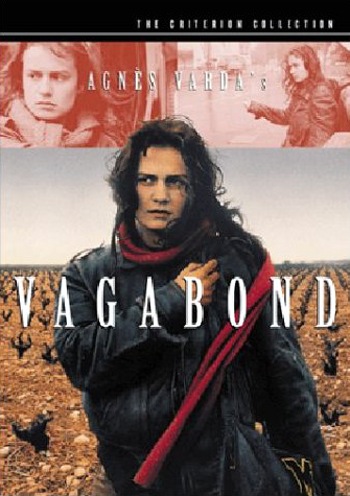
Way before that, in 1985, French director, Agnes Varda, made Vagabond, or to give it its French title Sans toit ni loi, which translated literally means "Without Roof or Rule". Like Into The Wild it's about a young woman, Mona, who lives on the road and has no place to call her own. Relying instead on the kindness of others to survive.
A fictional tale, the main thing that separates it from Into The Wild is that the lead character has none of the lust for life that Penn's movie does. Where as Hirsch's character is able to bring a lot of warmth and encouragement to the people he comes across, Mona seems like much too broken a character to be able to do the same thing, and will sometimes greet kindness with a special kind of apathy.
In fact, the true nature of her character is at the centre of the film. Characters address the camera, at various points in the story, expressing their experiences with her, and opinion on her. All differ wildly. What they do have in common in that they reflect something of their own prejudices and outlook.
 These differing perspectives give the movie an added dimension, as we the audience are invited to piece together who Mona really was, and whether she was a victim of circumstance or a master of her own fate.
Overall, there's a lot to like in this film. The faux-documentary style, the ambiguous nature of the main character, and the way people's opinions reveal more about themselves than about the person they're describing all make this film very easy to recommend.
I started this series based on titles I was studying at an evening course at Edinburgh University. Vagabond marks the end of the course, and so the end of the series. If you've missed any of the Film School articles, just click here.
My next series will be "Films of Shame". That is films, I really should have seen by now, but haven't.
The first five will be:
1. Citizen Kane
2. Godfather Part 2
3. The Shining
4. Taxi Driver
5. Annie Hall
I'd be interested to know other people's "Films of Shame". Have you never seen "Star Wars", "Schindler's List" or "The Wizard of Oz"? Do you have to pretend to know what's so special about Bruce Willis' watch in Pulp Fiction? Or do you sometimes intersperse conversations about Lord of the Rings, with "My Precioussssss" in the hope no one will find out your guilty secret?
Confessions welcome below:


 One of the most influential movie of the 90s was Tarantino's Pulp Fiction. Combining style, instantly quotable dialogue, and a non-linear, multi-threaded narrative it became an instant classic when it was released in 1994. Watching it back now, it still feels like a very recent, modern film.
  The MPDG in this case is Faye, who dances around to California Dreamin'; breaks into the male lead's apartment so she can clean it and rearrange furniture; and glides across our screens with few concerns beyond making sure the music is loud enough so she can't think.
 The western is a genre known for the unwavering codes and morals of their protagonists. Heroes will do anything to defend their town from the tyranny of an outsider. Law, order, and honour are all at the heart of the society they inhabit, and nothing will force them to reconsider this strict ethical code.
 In particular, its critique of capitalism (around half way through the movie, McCable is confronted with a 'hostile takeover' - literally) would certainly ring true with the fans of The Wire. As success brings him to the attention of outside forces who make him an offer he can't refuse.

 Eyes Wide Shut was the last film Stanley Kubrick directed before he died. It stars Tom Cruise and Nicole Kidman as a married couple, and was famous at the time for being slated by critics for what it wasn't. Cruise and Kidman were not chosen for their on-screen chemistry (of which there is little, but neither is there opportunity for much); they weren't necessarily chosen for their wide-reaching acting abilities (even if they were, the dialogue gives them little opportunity for oscar-worthy performances); finally it isn't the most sexy mainstream movie ever made, despite what censors at the time would have you believe.
 Finally, the dialogue, as already alluded to is deceptively simple. Exchanges are so one dimensional, they must surely have hidden depth. As a result characters feel like actors playing roles.
 Meantime is directed by Mike Leigh and stars Phil Daniels, Gary Oldman, Tim Roth, Pam Ferris, and Alfred Molina (among others). Leigh is film-maker known for his unique approach to movies. Rather than writing a script and getting actors to perform lines, he creates characters and a basic storyline, and works with the actors/actresses to create a script. Once the actors have been told about who their characters are, Leigh will put them in a room together and let them improvise lines. This gives each of his movies very natural and realistic dialogue, at the expense of a tight story or obvious character arcs.
 In Meantime characters will often be so involved in their own worlds, that they aren't actually listening to what the other person is saying, or don't quite get it. How many times have you been in a conversation where your mind is elsewhere, or you kind of half answer a question? The other thing you get is the sense of conversing to fill the awkward silence that often fills the air between two people. So that dialogue is not interesting because of what is being said, but because it reflects a more realistic form of conversation rarely seen in film.
 This week's
  For my money, it appears as though Godard is determined to do nothing you would expect in a narrative movie: so story, plot, and character arcs are practically non-existent. However, in loosing what he feels are the chains of classic cinema, I feel like he's shackled himself up to new restrictions. Only shooting in a way that's challenging and unique for his own pleasure/challenge, rather than in a manner that gives his audience any insight into the world he's created. His movies perhaps say more about film-making than they do their subjects.
  This week's film is a Japanese one called Shonen, which translated into French means 'garçon'. It's about a boy who's parents get him to fake accidents with cars in order to win compensation. Based on a true story, the family goes from city to city defrauding innocent drivers - playing on their guilt for hitting a helpless child.
 Where as a lot of movies nowadays show cruelty by children as a result of a broken society (City of God, Let The Right One In, etc.), Shonen has a much more simple explanation for its lead character's lack of morality, and one that is much easier to understand and empathise with. It's his parent's fault.
 On Wednesday, I started an evening course at Edinburgh University called "Talking Film". The format of the course if fairly simple: you watch a film and then discuss it with one another at the 2-hour class. The lecturer leads the discussion, and shows the clip from the film itself, as well as other clips relevant to its genre/stars/director. Over the next ten weeks, I'll try and review each of the ten films I'll be watching.
 Chinatown borrows heavily from the tropes of Film Noir: a male lead with few ties, a femme fatale, and a dark mystery to be solved. However, without spoiling anything, the resolution to the film's plot manages to make it much more than a simple detective story.
 There are a number of reasons I feel this way. One is that the photography lacks a 'cinematic quality'- the film could easily be adapted for the stage without losing much in the translation. In addition, the plot and characters could almost be considered 'too tight': every action and conversation can be brought back to a specific motivation or event. You're not given the impression there's anything else going on in these characters lives aside from the occurrences we see or hear about in the film.


